
Originally Published: November 20, 2025 | Updated: July 2026 | Reading Time: 9 min
Topics: Motor Topology • Humanoid Robotics • Soft Magnetic Composites
Small Motors, Big Moves: How SMC-Enabled Motor Geometries Are Accelerating Humanoid Robotics
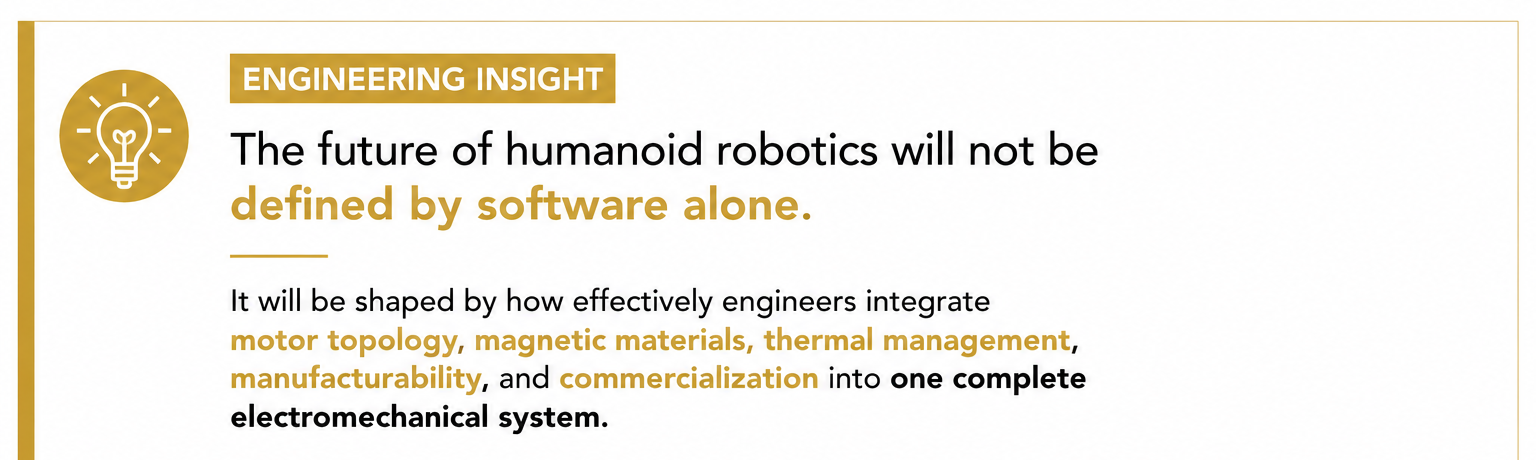
Humanoid robotics is moving quickly from research laboratories into factories, hospitals, warehouses, and commercial environments. As these machines become more capable, one engineering challenge is becoming increasingly clear: motor design.
Unlike traditional industrial robots, humanoids require dozens of compact electric motors that deliver high torque density, precise motion, low weight, efficient thermal management, and long-term reliability, all while remaining manufacturable at production scale.
Meeting those requirements takes more than improving an existing motor. It requires engineers to think differently about motor topology, magnetic materials, packaging, and manufacturability. Soft Magnetic Composites, or SMCs, are helping expand that design space by enabling motor geometries that are difficult to manufacture with conventional laminated steel.
Why Humanoid Robotics Is Changing Motor Design
Imagine a robot moving through a hospital hallway, delivering supplies, helping staff lift heavy trays, and navigating around people without requiring special infrastructure. That is the promise of humanoid robotics: machines designed to work in environments built for people.
Unlike traditional industrial robots that are often fixed in place or separated from people, humanoids must climb stairs, manipulate objects, maintain balance, and move with human-like dexterity. Those movements depend on compact actuators placed throughout the body, including the hips, knees, ankles, shoulders, elbows, wrists, and hands.
The opportunity is significant. Humanoid robots could help address labor shortages, support repetitive or hazardous work, and improve productivity across logistics, manufacturing, healthcare, retail, and service environments. Behind that opportunity is a difficult engineering reality: making humanoids commercially viable requires innovation inside the motor.
Why Motors Are the Bottleneck for Humanoid
Robots
The closer robots move toward human form, the more demanding motor design becomes. Unlike a traditional industrial arm that may repeat one motion from a fixed base, a humanoid robot requires dozens of coordinated actuators working simultaneously. Each joint introduces competing requirements.
A hip actuator must generate high torque while staying compact. A wrist joint needs precise motion in a very small package. An ankle motor must support balance, dynamic loading, and repeated movement. Across the entire robot, every added gram affects battery demand, actuator sizing, and overall system efficiency.
This creates several design challenges:
-
Motors must fit inside compact joints without increasing the robot’s frame size.
-
Torque density must improve without adding unnecessary weight.
-
Heat must be managed during continuous operation.
-
Designs must scale beyond prototypes into repeatable manufacturing.
The challenge is not simply building a better motor. It is building a better motor that fits the robot, supports the motion profile, manages heat, and can be manufactured consistently.
What Is Motor Topology?
Motor topology describes the physical arrangement of the stator, rotor, windings, air gap, and magnetic circuit inside an electric motor. More importantly, it defines how magnetic flux travels through the machine.
Topology influences much more than efficiency. It affects torque density, package size, cooling strategy, material selection, manufacturability, and production scalability.
For humanoid robotics, topology selection is becoming one of the earliest and most important motor design decisions.
Why Motor Topology Matters
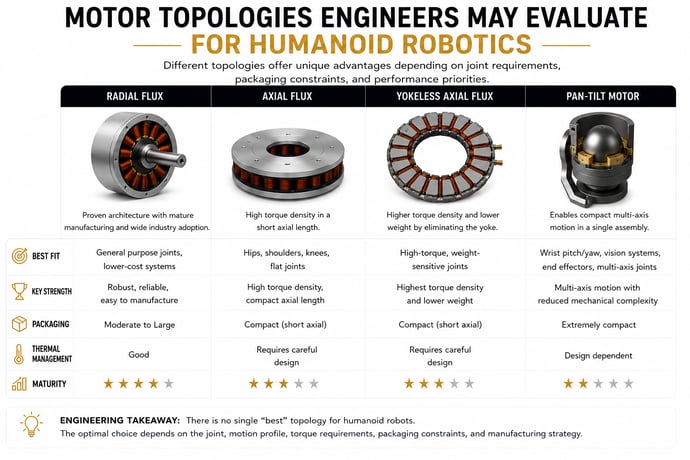
For decades, engineers have relied on radial flux motors built with laminated steel cores. These motors continue to serve many automotive and industrial applications well because they are reliable, proven, and supported by mature manufacturing processes. Humanoid robots, however, create packaging challenges that push engineers to evaluate alternatives.
- Axial flux motors (including yokeless designs) offer higher torque density in flatter packages, making them ideal for joints.
- Segmented or modular topologies allow designers to customize motors for tight spaces like wrists or ankles.
- Emerging motor designs, such as spherical or pan tilt motors, enable rotational angular movement within a single motor design.
- Novel flux paths can unlock efficiency and reduce heat, which is critical for long-duty cycles.
Each topology brings tradeoffs. A motor that offers strong torque density may introduce cooling, assembly, or manufacturing challenges. A motor that is easy to produce may not provide the packaging flexibility required for advanced robotics. The question is not which topology is universally best.
The better question is: Which motor architecture best supports the motion, package, thermal requirements, and manufacturability of the joint?
The SMC Advantage
Soft Magnetic Composites (SMC) are helping engineers rethink what is possible in electric motor design.
Unlike traditional laminated steel, SMCs are produced from insulated iron powder particles compacted into complex three-dimensional shapes. This structure allows magnetic flux to travel in three dimensions while helping reduce eddy current losses in complex flux paths.
For humanoid robot design, that additional design freedom matters.
SMCs can support stator geometries that follow the natural contours of a joint rather than forcing the joint to adapt to a traditional motor shape. They can enable compact cores, segmented stators, pre-wound assemblies, and modular motor designs that are difficult to achieve with stacked laminations.
In practical terms, SMCs can help engineers pursue four important goals:
3D net shape cores
Designers can create geometries that better fit compact robotic joints, such as hips, wrists, and ankles.
Lower eddy current losses
SMCs can reduce losses in complex magnetic circuits, helping manage heat during continuous operation.
Improved torque density
When paired with the right topology, SMCs can help deliver more torque in a smaller volume.
Manufacturability at scale
Powder metallurgy supports near-net shape production, repeatable components, and manufacturing paths that can move from prototype to production.
SMCs do not eliminate every motor design tradeoff. They expand the range of architectures engineers can realistically evaluate.
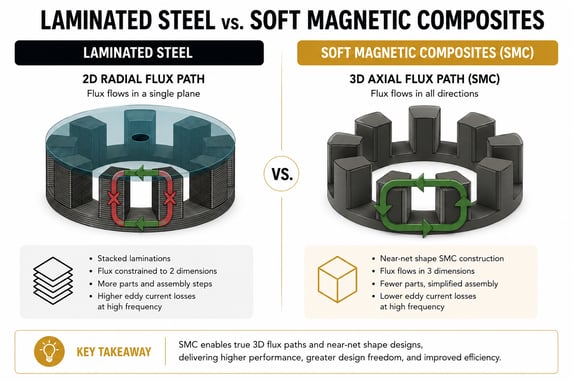
Image: SMCs expand motor design freedom by enabling three-dimensional magnetic circuits and complex near-net shape geometries.
Engineering in Practice
Compact Hip Actuators
A humanoid robot’s hip joint is one of its most demanding actuators. It must generate high torque while staying compact enough to preserve natural movement and minimize total system weight.
By using advanced motor topologies with SMC stators, engineers can explore slimmer actuator designs that increase torque density while supporting more manufacturable core geometries. The result is a hip module that can reduce weight, improve energy efficiency, and help preserve overall robot mobility.
Wrist and Ankle Joints
Smaller joints create a different challenge. Wrist and ankle actuators must fit into limited spaces while maintaining precise motion and continuous-duty performance.
Modular SMC stators can support pre-wound coils, improved cooling paths, and repeatable assembly. This helps improve thermal behavior and manufacturability, which becomes critical when moving beyond prototype builds.
Pan-Tilt and Multi-Axis Concepts
.png?width=154&height=154&name=Untitled%20design%20(11).png) Pan-tilt motor designs are still early in development, but they point to an important direction in robotics: reducing mechanical complexity by integrating more motion into the motor itself.
Pan-tilt motor designs are still early in development, but they point to an important direction in robotics: reducing mechanical complexity by integrating more motion into the motor itself.
Because these concepts often require more complex magnetic paths, SMCs may provide value through isotropic magnetic behavior and near-net shape manufacturing. This is an area where material selection and motor topology should be evaluated together from the beginning.
Why This Matters for Manufacturers and Suppliers
For companies advancing humanoid robotics, motor design decisions influence more than performance. They affect cost, validation timelines, supplier strategy, product reliability, and time-to-market.
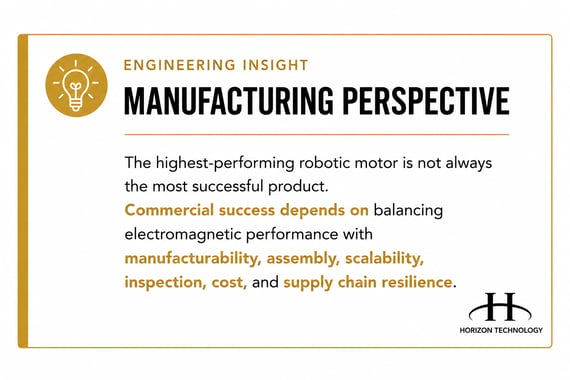
A motor that performs well in simulation still needs to be manufactured, wound, assembled, inspected, and scaled. If manufacturability is treated as a downstream issue, development teams may discover too late that a promising design is difficult or costly to produce.
That is why motor topology, materials, and manufacturing strategy should be considered early in the development process.
A co-development approach helps teams model SMC-enabled geometries, prototype critical concepts, validate performance, and build a realistic path toward production. This reduces technical risk while improving the chances that a promising actuator design can become a commercial product.
Looking Ahead
Humanoid robotics is still in the early stages of commercialization. As robots become more capable, motor design will become more important, not less.
Future breakthroughs are unlikely to come from one single motor architecture or material. They will come from engineering teams that understand how topology, magnetic materials, thermal management, packaging, and manufacturability work together.
The next generation of humanoid robots will need motors that are smaller, lighter, quieter, more efficient, and easier to produce. That will require more than optimizing familiar designs. It will require better design decisions earlier in the process.
Key Takeaways:
-
Humanoid robots require compact motors that balance torque density, weight, efficiency, thermal behavior, and manufacturability.
-
Motor topology affects much more than torque. It influences package size, cooling, material selection, and production scalability.
-
Axial flux, yokeless axial flux, segmented, and pan-tilt designs create new opportunities for compact robotic actuators.
-
Soft Magnetic Composites expand the design space by enabling three-dimensional flux paths and complex near-net shape geometries.
-
Manufacturability should be considered during concept development, not after the motor has already been designed.
Ready to Take the Next Step?
Whether your team is developing compact robotic actuators, evaluating advanced motor topologies, or exploring manufacturable SMC-enabled designs, Horizon Technology can help connect electromagnetic performance with production reality.
Book a design workshop with our engineering team to explore how SMC-enabled motor geometries could support your next robotics program.
FAQ:
Why are humanoid robot motors different from industrial motors?
Humanoid robots require compact actuators that fit inside joints similar to the dimensions of the human body. These motors must deliver high torque, precise motion, low weight, and continuous-duty performance while supporting the robot’s balance and mobility.
Why is motor topology important in humanoid robotics?
Motor topology defines how magnetic flux travels through the motor and how torque is produced. It influences torque density, package size, thermal behavior, manufacturability, and overall system performance.
Are axial flux motors better for humanoid robots?
Not always. Axial flux motors can provide high torque density in a compact package, which makes them attractive for some robotic joints. However, every topology has tradeoffs related to cooling, assembly, air-gap control, and manufacturability.
What are Soft Magnetic Composites?
Soft Magnetic Composites are magnetic materials made from insulated iron powder particles compacted into complex shapes. They allow three-dimensional magnetic flux paths and can enable motor geometries that are difficult to manufacture with laminated electrical steel.
How do SMCs improve robotic motors?
SMCs expand design freedom. They can support compact stator geometries, segmented motor designs, lower eddy current losses in complex flux paths, and near-net shape manufacturing.
Can SMCs replace laminated steel in every motor?
No. Laminated steel remains an excellent choice for many motor designs. SMCs are most valuable when an application benefits from three-dimensional flux paths, compact geometries, high-frequency performance, or advanced topology design.
What is a pan-tilt motor?
A pan-tilt motor is an emerging motor concept designed to support angular or multi-axis motion within a compact assembly. These designs may be useful for robotic wrists, vision systems, sensor gimbals, and end effectors.
Why does manufacturability matter in humanoid robot motors?
A motor must do more than perform well in simulation. It must be produced repeatably, assembled efficiently, inspected reliably, and scaled economically. Manufacturability determines whether a motor concept can become a commercial product.