
Executive Summary
Selecting the right motor topology begins long before engineers compare radial flux, axial flux, or transverse flux architectures.
One of the earliest - and often most influential - design decisions is operating voltage.
Voltage determines current levels, thermal behavior, winding strategy, cooling requirements, and ultimately which motor topologies become practical to manufacture and operate efficiently.
Rather than evaluating voltage, topology, and magnetic materials independently, successful electric machine development treats them as an integrated engineering system.
Key Takeaway: Operating voltage is more than an electrical specification - it is a system-level design input that influences nearly every engineering decision that follows.
How Does Operating Voltage Affect Motor Topology?
Operating voltage influences motor topology because it determines current density, heat generation, winding requirements, and cooling strategy.
Lower-voltage systems prioritize torque production while managing high current. Higher-voltage systems reduce copper losses but introduce new challenges related to mechanical integrity, insulation, rotor dynamics, and magnetic losses.
The most effective motor architectures balance operating voltage, topology, magnetic materials, and manufacturability together rather than optimizing each independently.
Introduction
When engineers evaluate motor topologies, the conversation often starts with geometry - radial flux vs. axial flux, or newer architectures like yokeless axial flux.
But the most important design input usually comes earlier - and is often overlooked: operating voltage.
Voltage doesn’t just influence performance. It defines how power is delivered, shaping current levels, thermal behavior, winding strategy, and ultimately which motor topologies are viable.
The most effective motor designs don’t treat these variables independently. They emerge when voltage, topology, and materials are considered as a unified system.
Why Voltage Should Come Before Motor Topology
Operating voltage doesn’t simply influence one aspect of motor performance.
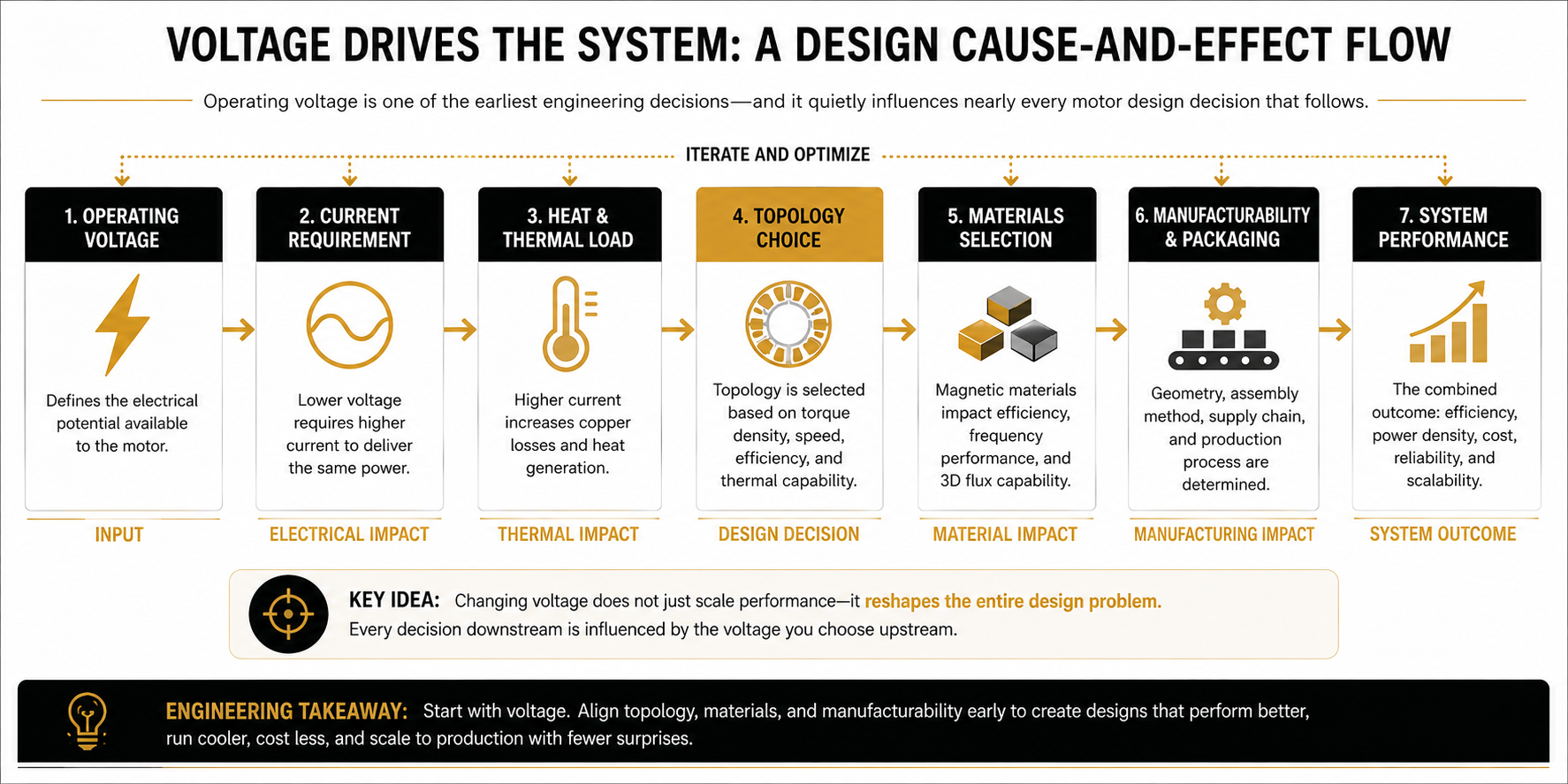
It establishes a chain of engineering decisions that affects current density, thermal management, cooling strategy, motor topology, magnetic material selection, manufacturability, and ultimately overall system performance.
Understanding these relationships helps explain why voltage should be considered one of the earliest design decisions in electric machine development.
The Engineering Insight
Operating voltage is not simply an electrical specification—it is one of the earliest system-level design decisions. By aligning voltage, motor topology, magnetic materials, and manufacturability from the beginning, engineering teams can develop electric machines that are more efficient, easier to manufacture, and better optimized for commercialization.
Why Operating Voltage Is a First-Order Design Constraint
At a system level, voltage determines how efficiently power can be delivered.
Lower-voltage systems require higher current to achieve the same output. That increase in current drives resistive losses, elevates heat, and places pressure on copper utilization and cooling strategies.
As voltage increases, current decreases. This reduces copper losses and improves efficiency, but introduces new challenges - particularly around high-speed operation, rotor integrity, and magnetic losses at higher frequencies.
This transition is critical. It means voltage doesn’t simply scale performance - it reshapes the design problem entirely.
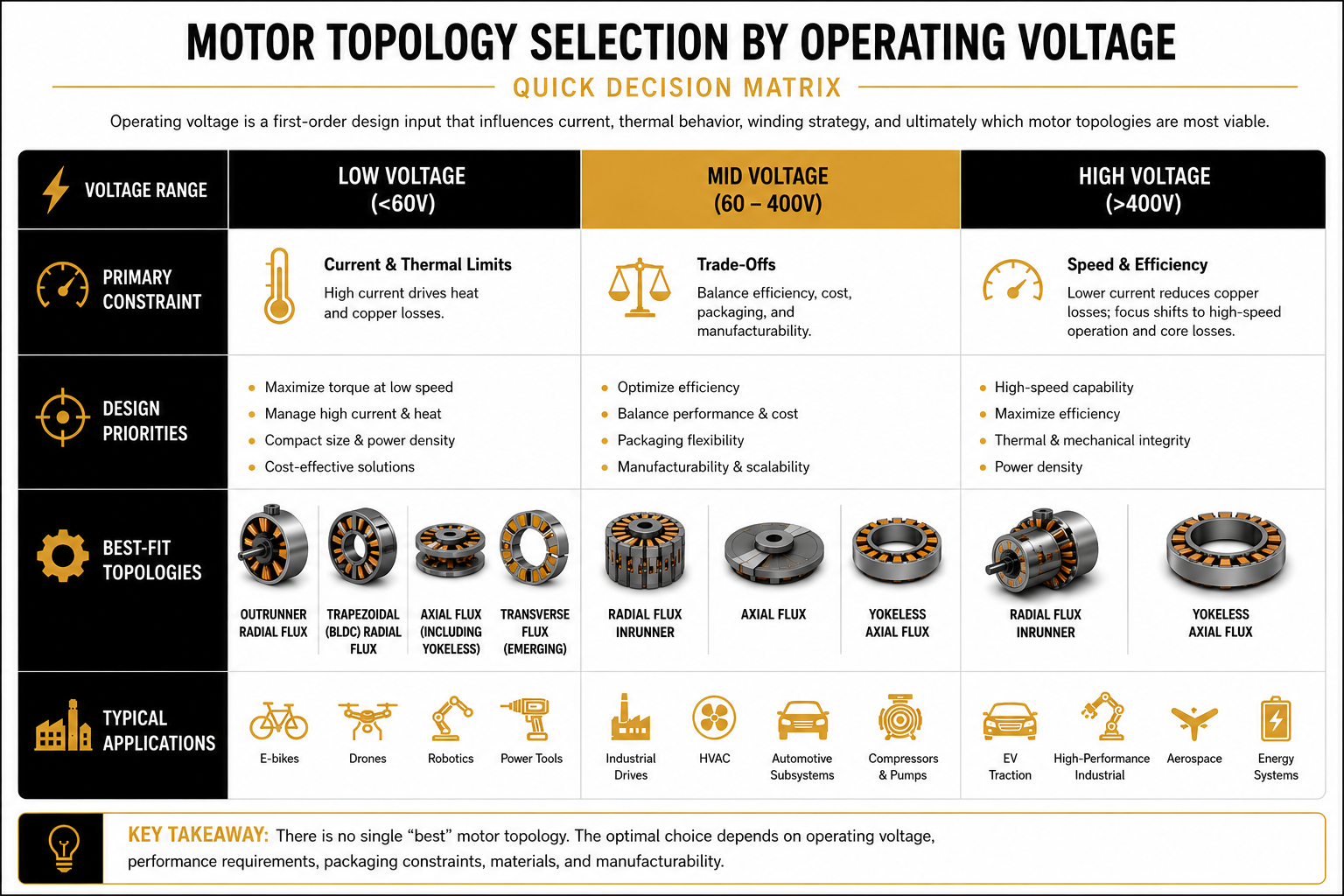
Low Voltage (<60V): Designing Around Current and Thermal Limits
In low-voltage systems, current is the dominant constraint. Applications such as e-bikes, drones, and compact robotics platforms operate under tight voltage limits, forcing designers to manage high current and the thermal challenges that come with it.
Outrunner Radial Flux Motors
Outrunner motors remain a preferred solution for many low-voltage applications because their larger effective air-gap radius produces high torque at lower speeds while minimizing current demand.
Trapezoidal (BLDC) Radial Flux Motors
BLDC motors provide an excellent balance between performance, electronics simplicity, manufacturability, and cost, making them common in high-volume applications.
Axial Flux Motors (Including Yokeless Designs)
Axial flux motors provide higher torque density in a compact package while reducing end winding length and copper losses.
Yokeless axial flux designs extend these benefits by enabling more efficient magnetic flux paths and supporting more advanced geometries.
Engineers evaluating compact, high-torque applications may also benefit from understanding how radial flux, axial flux, and transverse flux motor architectures compare.
Why Materials Begin to Matter
As engineers pursue higher torque density within compact packages, magnetic material selection becomes increasingly important.
Advanced materials such as Soft Magnetic Composites (SMCs) enable three-dimensional magnetic flux paths and compact stator geometries that simplify manufacturing while supporting advanced motor architectures. This becomes particularly valuable when evaluating axial flux, yokeless axial flux, and transverse flux concepts.
Transverse Flux Motors (Emerging)
Transverse flux motors separate magnetic and electric loading, enabling exceptionally high torque at low speed. Historically limited by manufacturing complexity, advances in Soft Magnetic Composites are making these designs increasingly practical.
Mid Voltage (60–400V): Where Motor Design Becomes a Trade-Off
As systems move into the mid-voltage range, multiple motor topologies become viable. Efficiency, cost, packaging, manufacturability, and application priorities begin competing with one another.
High Voltage (>400V): Optimizing for Speed and Efficiency
At higher voltages, lower current reduces copper losses, shifting engineering priorities toward rotor integrity, insulation, mechanical strength, and magnetic losses at higher operating frequencies.
Magnetic Material Selection Is Becoming a Design Decision
Motor topology does not determine motor performance alone.
Increasingly, magnetic material selection influences which topologies can be manufactured efficiently at production scale.
Traditional laminated electrical steel remains the benchmark for many radial flux applications. However, as motor architectures become more compact and magnetic circuits become increasingly three-dimensional, engineers are evaluating alternative materials capable of supporting more complex geometries.
SMCs allow magnetic flux to travel in three dimensions while enabling near-net-shape manufacturing, segmented stator construction, and greater geometric flexibility.
Rather than replacing laminated electrical steel, SMCs expand the range of practical motor architectures available to the design engineer.
For many next-generation electric machines, topology and material selection have become inseparable engineering decisions.
Key Engineering Considerations
- Operating Voltage
- Current Density
- Duty Cycle
- Cooling Strategy
- Torque Density
- Package Constraints
- Manufacturing Method
- Magnetic Materials
- Long-Term Scalability
A Smarter Approach to Motor Topology Selection
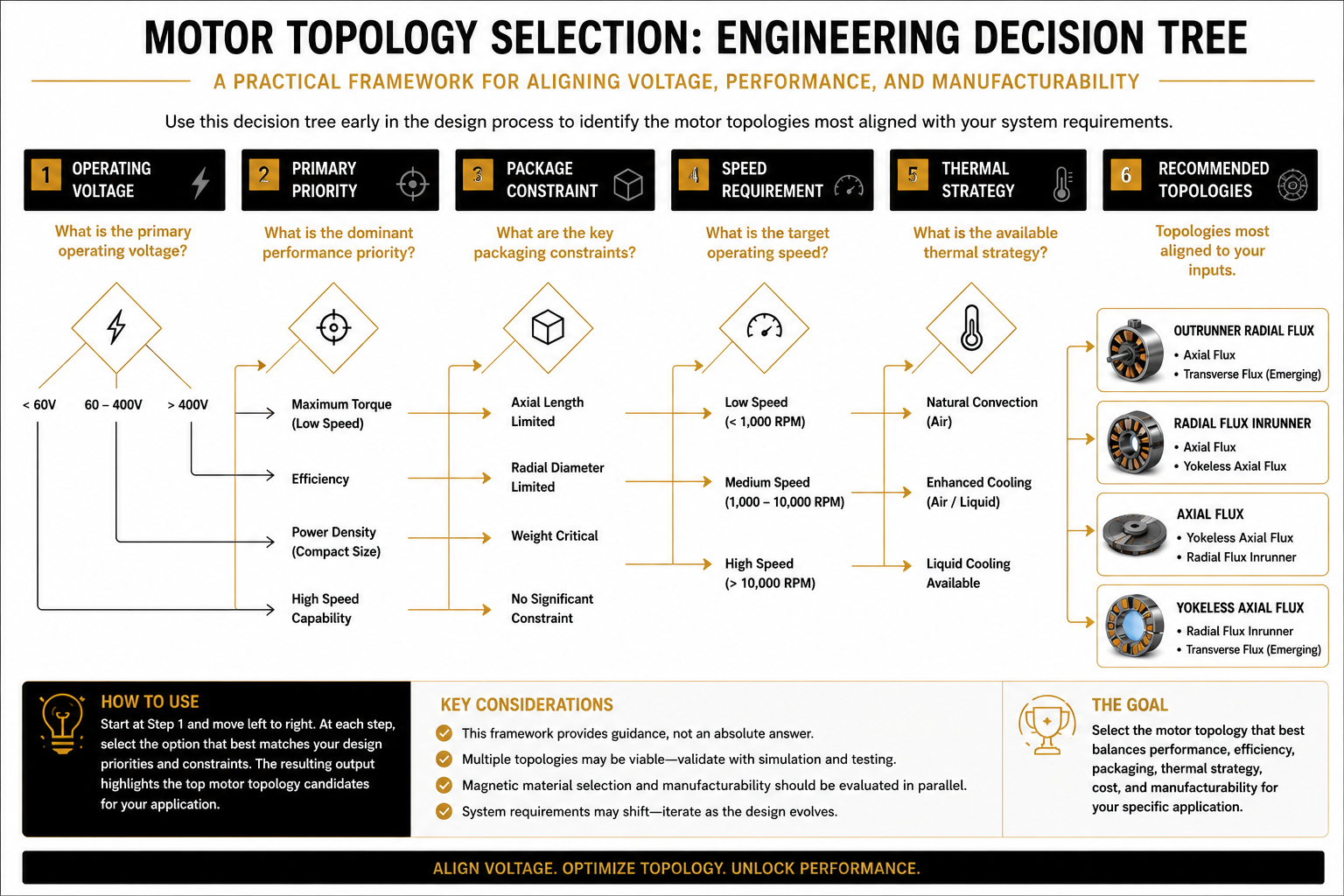
So, which motor topology best aligns with operating voltage, performance requirements, packaging constraints, magnetic materials, and manufacturability?
Engineering decisions rarely depend on a single variable. The most successful electric machines result from evaluating these design inputs together rather than optimizing one in isolation.
Figure 3 illustrates a practical engineering framework for evaluating motor topology selection during concept development.
Frequently Asked Questions
Why does operating voltage influence motor topology?
Operating voltage determines current levels, thermal behavior, winding strategy, and cooling requirements, all of which influence which motor architectures are practical.
Which motor topology works best below 60 volts?
There is no universal answer. Outrunner radial flux, BLDC, axial flux, and transverse flux motors may all be appropriate depending on application priorities.
Why do higher-voltage systems favor different motor topologies?
Higher voltage reduces current and copper losses while shifting design priorities toward speed, insulation, rotor integrity, and magnetic losses.
Does operating voltage influence material selection?
Yes. Voltage, frequency, and topology influence which magnetic materials provide the best balance of efficiency and manufacturability.
Are Soft Magnetic Composites replacing laminated electrical steel?
No. SMCs complement laminations by expanding the range of practical motor architectures.
When should engineers consider motor topology?
During concept development alongside voltage, materials, cooling, and manufacturability - not afterward.
Article in Brief
- Operating voltage influences nearly every downstream motor design decision.
- Lower-voltage systems prioritize current management and torque density.
- Higher-voltage systems prioritize efficiency, speed, and structural integrity.
- Material selection increasingly expands available motor architectures.
- The best electric machines optimize voltage, topology, materials, and manufacturability together.
Designing the Next Generation of Motor Architectures
Ultimately, the most successful electric machine designs begin by asking better engineering questions.
Rather than searching for a universally superior motor topology, leading development teams evaluate how operating voltage, thermal management, magnetic materials, manufacturability, and application requirements interact as a complete system.
Operating voltage is not simply an electrical parameter - it is one of the first engineering decisions that quietly shapes every decision that follows.