
Modern applications - robotics, electrification, aerospace, micro-mobility, and compact industrial systems - are pushing motor design into a different set of constraints.
Torque density, efficiency, and packaging are no longer independent goals. They must be achieved simultaneously.
That shift is exposing a limitation in how motor design has traditionally been approached.
The familiar sequence - select a topology, optimize geometry, refine materials - assumes the system can be shaped after key decisions are made. In practice, the opposite is true.
The system exists before optimization begins.
Early assumptions around voltage, thermal limits, packaging, and manufacturing quietly define what the motor can no longer become.
This is where the design process begins to break from its traditional structure.
What follows is not a different set of tools - but a different way of structuring decisions.
The Sequence That Shaped Motor Design
For decades, motor design followed a structured progression. Requirements were defined, a topology was selected, and the design was refined through geometry, material selection, and manufacturing validation - each step built on the last, creating a clear and efficient path from concept to production.
This approach worked because the system allowed it to. Design margins were wider, constraints were less tightly coupled, and manufacturing paths were relatively fixed. Under those conditions, decisions could be made sequentially and adjusted later without significantly impacting the outcome.
However, this structure also introduced an assumption - that decisions could be made independently and corrected downstream. As constraints tighten and systems become more integrated, that assumption is no longer valid.
Why That Sequence Is Breaking Down
Modern motor design operates within a system where key variables are tightly interconnected from the outset. Decisions related to voltage, thermal behavior, packaging, and manufacturing do not act independently - they influence one another immediately and continuously.
For example, a change in operating voltage affects current levels and thermal loading. That thermal behavior, in turn, constrains allowable geometry and material selection. Geometry then determines which motor topologies are viable, while manufacturing capabilities define what can realistically be produced.
These relationships are not sequential - they are simultaneous.
When treated as a step-by-step process, these interactions surface late, often as constraints that require workaround solutions. When treated as a system, they can be evaluated early, shaping the design space before it becomes restricted.
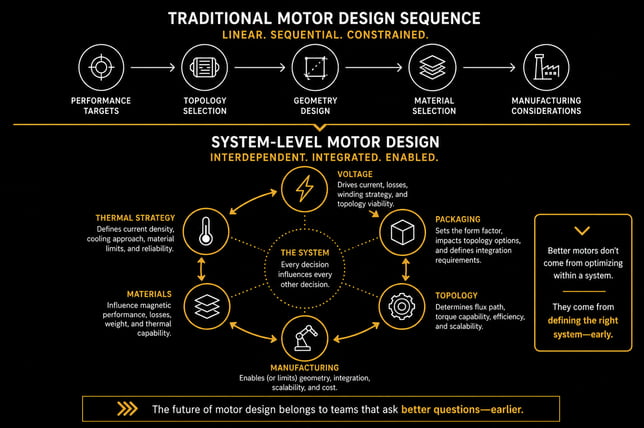
Image 1: Traditional motor design follows a linear sequence. Modern motor design operates as an interconnected system.
Voltage Is a System-Level Decision
Voltage is often treated as an external input - something defined by the system and applied to the motor design. While this is true in a practical sense, it understates its impact.
In reality, voltage plays a foundational role in shaping the system. It determines current levels, which directly influence copper losses, conductor sizing, and thermal loading. These electrical characteristics affect winding strategies, cooling requirements, and ultimately the physical structure of the motor.
As a result, voltage does not simply influence performance - it defines the conditions under which performance must be achieved.
👉 Explore this further: Motor Topology Selection by Voltage
Thermal Strategy Defines the Boundaries
Thermal behavior is often where design limitations become visible, but it is rarely where they originate. In most cases, thermal constraints are the result of earlier electrical and geometric decisions - particularly those related to voltage, current density, and available cooling paths.
By the time thermal limits are identified, the design has already been shaped in ways that are difficult to reverse. At that stage, improvements typically take the form of compensatory measures such as increased cooling capacity, additional material, or greater system complexity.
While these adjustments can resolve immediate issues, they do not fundamentally improve the design.
A more effective approach is to treat thermal strategy as a primary design variable. By considering allowable current density, cooling methods, and heat transfer paths early in the process, thermal performance becomes part of the system definition rather than a constraint that must be managed later.
Packaging Drives Architecture
Packaging is often described as a constraint - a fixed volume the motor must fit within. In practice, it plays a much more active role in shaping the design.
The available space defines not only size, but also form factor, rotor configuration, and the feasibility of different topologies. For example, a thin axial envelope naturally favors axial flux or yokeless axial flux designs, while a wider radial space may lend itself to outrunner configurations. More complex or irregular volumes can enable segmented or three-dimensional architectures that would not otherwise be considered.
Because of this, packaging is not simply a boundary condition applied to a completed design. It is a factor that influences which designs are viable from the beginning.
Recognizing this earlier allows engineers to explore architectures that align more naturally with the application, rather than adapting a predefined solution to fit within imposed constraints.
Manufacturing Defines What Gets Considered
Manufacturing is often introduced late in the design process as a validation step. By that point, the architecture, geometry, and material selections have already been established.
However, manufacturing does more than validate a design - it shapes which designs are considered in the first place.
Traditional lamination-based processes favor planar, repeatable geometries, which naturally guide designs toward established topologies. This is not necessarily a limitation of engineering capability, but rather a reflection of what is practical to produce at scale.
Emerging manufacturing methods, such as powder metallurgy and soft magnetic composites (SMC), expand the design space by enabling more complex geometries and three-dimensional flux paths. These approaches allow for greater integration and can reduce constraints imposed by traditional fabrication methods.
However, these advantages only influence the final outcome if they are considered early. If introduced after the design is largely defined, they are unlikely to change the overall architecture.
The Motor Design Sequence Is Becoming a System
The variables involved in motor design have not changed.
What has changed is how they must be considered.
Instead of following a linear progression, motor design is increasingly approached as a system-level evaluation, where voltage, thermal strategy, packaging, topology, materials, and manufacturing are assessed together.
Voltage ↔ Thermal Strategy ↔ Packaging ↔ Topology ↔ Materials ↔ Manufacturing
In this model, decisions are not made in isolation or in sequence. They are explored in relation to one another, allowing the design space to be understood before it is constrained.
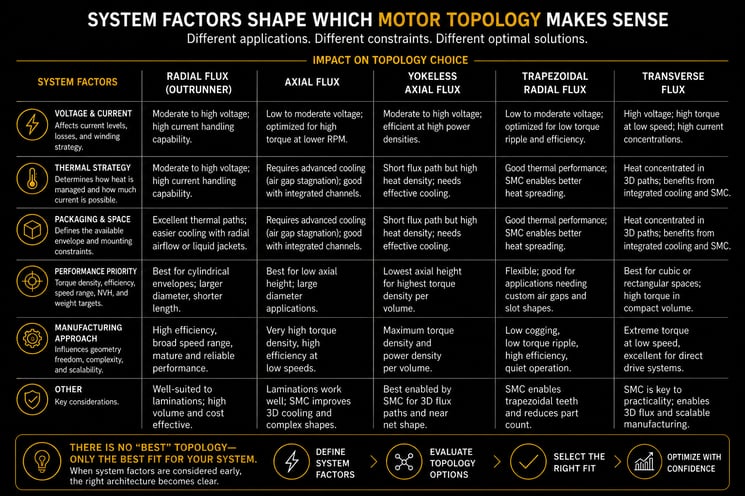
Image 2: Motor topology is not a standalone decision—it’s shaped by system-level factors like voltage, thermal limits, packaging, and manufacturing.
What This Looks Like in Practice
Consider a compact robotic joint application.
The requirements are familiar: high torque density, tight packaging, and limited voltage. In many cases, low-voltage systems drive high current, which quickly introduces thermal challenges - especially in confined spaces where heat is difficult to remove.
A conventional approach often starts with a radial flux design, optimized over time through improved cooling, increased material, and geometric refinement. Early on, this can appear to meet requirements.
But as the design progresses, the system begins to push back.
Higher current increases copper losses. Thermal limits constrain further gains. Cooling becomes more complex, particularly within tightly integrated assemblies.
At that point, the design is no longer being optimized - it's being managed.
This is where some teams step back and revisit the system itself.
Rather than continuing to refine the existing architecture, they reassess how torque is produced within the available space. In these cases, axial flux designs are often reconsidered - not as a new concept, but as a better alignment with the constraints.
Because torque is generated at a larger effective radius, axial flux machines can achieve higher torque density within shorter axial lengths - making them well-suited for compact, integrated systems.
However, this shift introduces new considerations. Thermal management becomes more critical, particularly as torque density increases within compact geometries.
Historically, manufacturing has also been a limiting factor. Complex geometries - especially those aligned with axial or three-dimensional flux paths - were difficult to produce using traditional lamination-based methods.
That constraint is beginning to change. Manufacturing approaches such as powder metallurgy and soft magnetic composites (SMC) are enabling these geometries to be produced more efficiently, aligning design intent with manufacturability in a way that was not previously practical.
The result is not simply a different motor.
It is a different starting point - one where voltage, thermal strategy, packaging, and manufacturing are aligned earlier in the design process.
What This Means for Motor Design
This shift changes the starting point of motor design.
Rather than asking which topology is best, the focus shifts toward understanding the conditions that allow the right topology to emerge. This requires evaluating system-level variables early and recognizing how they interact.
By doing so, engineers can avoid the need for reactive adjustments later in the process and instead develop solutions that are aligned from the beginning.
The result is not just improved performance, but more efficient development cycles and more robust designs.
Motor design is not becoming more complicated.
It is becoming more interconnected.
As performance requirements increase and constraints tighten, the advantage shifts toward teams that understand how these decisions interact—and how to structure them early in the process.
Evaluating a New Motor Architecture?
Horizon Technology works with engineering teams exploring:
-
axial flux motor development,
-
Soft Magnetic Composite (SMC) applications,
-
topology evaluation,
-
and manufacturable electromagnetic designs.
Connect with our engineering team to discuss your application
.
Frequently Asked Questions:
What is changing in the motor design process?
The motor design process is becoming more system-level and interconnected. Instead of optimizing topology, geometry, and materials sequentially, engineers increasingly evaluate voltage, thermal strategy, packaging, manufacturability, and topology together from the beginning of development.
Why is the traditional motor design sequence becoming less effective?
Traditional motor design assumed that decisions could be optimized independently and refined later. Modern applications with tighter packaging, higher torque density, and stricter thermal constraints require earlier coordination between electrical, thermal, mechanical, and manufacturing decisions.
How does voltage influence motor topology selection?
Voltage affects current levels, thermal loading, conductor sizing, and winding strategy. These factors directly influence which motor topologies are practical for a given application, especially in compact or high-performance systems.
Why is thermal strategy important early in motor development?
Thermal strategy defines allowable current density, cooling requirements, and material limits. When thermal considerations are introduced too late, engineers often rely on compensatory measures such as larger cooling systems or added complexity rather than improving the underlying architecture.
How does packaging affect motor architecture?
Packaging constraints influence motor form factor, rotor configuration, cooling paths, and topology feasibility. Thin/compact axial spaces may favor axial flux designs, while cylindrical packaging often aligns with radial flux architectures.
How does manufacturing influence motor design choices?
Manufacturing capabilities determine which geometries and topologies are practical to produce at scale. Traditional lamination methods favor planar geometries, while powder metallurgy and Soft Magnetic Composites enable more complex three-dimensional magnetic structures.
What role do Soft Magnetic Composites (SMC) play in modern motor design?
SMCs enable three-dimensional magnetic flux paths and more complex motor geometries that are difficult to achieve with traditional laminations. This allows engineers to align manufacturability and electromagnetic performance earlier in development.
Why are axial flux motors gaining attention in compact systems?
Axial flux motors can achieve high torque density within shorter axial lengths because torque is generated at a larger effective radius. This makes them attractive for robotics, electrification, aerospace, and compact integrated systems.
What is system-level motor design?
System-level motor design is an approach where voltage, thermal strategy, packaging, topology, materials, and manufacturing are evaluated together rather than sequentially. The goal is to understand design interactions early before constraints limit available solutions.