
Your motor simulation may be accurate. But does the magnetic material data behind it reflect what you can actually manufacture?
Electric motor development increasingly begins in simulation. Engineers can evaluate motor topologies, magnetic flux paths, estimate losses, and refine performance long before committing to a physical prototype.
These tools have changed how quickly new motor concepts can move from an idea to a viable design.
But even a sophisticated simulation depends on the quality of its inputs.
One of the most important considerations - and often overlooked - is the magnetic material data used to represent the stator or other magnetic components.
A model can be mathematically accurate and still predict performance that the finished component cannot deliver.
The difference often comes down to understanding where the material data originated, how it was measured, and whether it represents the conditions of the intended application.
What Does Your Magnetic Material Data Actually Represent?
When an engineer selects a material in electromagnetic simulation software, the material library typically provides B-H curves, permeability characteristics, and core-loss data. For electrical steel laminations, these properties are often established through standardized Epstein frame testing. While valuable for characterizing material behavior, these measurements do not necessarily account for the effects of manufacturing processes, component geometry, or the operating conditions of the finished motor.
This distinction becomes particularly important when working with Soft Magnetic Composites (SMCs).
Unlike conventional electrical steel laminations, SMCs are manufactured from insulated iron powder particles that are compacted into a defined geometry and typically undergo a controlled thermal treatment.
Material composition matters, but it is only part of the picture.
Component geometry and manufacturing conditions influence density distribution and thermal processing requirements. As a result, even components produced from the same powder grade can exhibit different magnetic properties.
The question, then, isn't simply whether the correct material was selected:
It's whether the material properties used in the simulation represent the condition in which that material will actually be used.
For engineers evaluating new motor architectures, understanding that distinction early can prevent unrealistic performance expectations later in development.
Are You Evaluating the Material Under the Right Operating Conditions?
A motor rarely operates at one speed/magnetic flux density or one frequency.
Its magnetic circuit experiences changing conditions based on speed, load, control strategy, and the local distribution of magnetic flux.
Yet material comparisons are sometimes made using a limited set of magnetic properties.
A high permeability value, for example, may appear attractive when comparing candidate materials. But permeability alone doesn't establish whether that material is the best choice for a particular motor.
Core losses, saturation behavior, and the intended operating range must also be considered.
This is especially relevant for advanced motor designs, including axial-flux, yokeless axial-flux, trapezoidal radial flux, and transverse-flux architectures, where magnetic flux paths and operating conditions differ significantly from conventional radial-flux machines.
SMCs offer an important design advantage through their ability to support three-dimensional magnetic flux paths. Their insulated powder-particle structure also reduces eddy currents.
However, these characteristics do not automatically make an SMC the most efficient choice in every application.
The operating conditions determine where the material's advantages become meaningful.
For example, a material that performs favorably at one frequency may exhibit a different loss relationship at higher frequencies. Similarly, the flux-density range used in a comparison can significantly influence the predicted result.
Engineers should therefore consider not just whether loss data is available, but whether it covers the conditions their motor will encounter.
The goal isn't to find the material with the most impressive individual property. It's to understand how the complete magnetic circuit will perform in the intended application.
What Will Your Prototype Actually Validate?
Simulation helps narrow design possibilities, while prototyping helps ascertain which assumptions hold up in practice. Depending on the development objectives, this may involve evaluating torque production, magnetic flux distribution, core losses, thermal behavior, or the feasibility of a particular stator geometry.
Each objective requires a slightly different validation strategy.
A prototype designed to evaluate mechanical fit and assembly can provide valuable insight into geometry and packaging, but may not fully validate the magnetic performance expected from a production-intent component. Even testing a complete motor can leave unanswered questions when measured performance differs from simulation, making it difficult to determine whether the variation stems from material properties, winding characteristics, manufacturing processes, or other design factors.
This is where the development process benefits from a more deliberate connection between simulation, material selection, and manufacturing.
Before building, engineers should identify which assumptions need to be tested and what evidence will confirm or challenge them.
That might involve testing representative magnetic specimens, measuring component-level properties, or evaluating a prototype motor under defined operating conditions.
The right approach depends on the maturity of the design and the level of confidence required for the next decision.
Rather than treating prototyping as a single milestone, consider it a sequence of opportunities to reduce uncertainty.
What Should Be Agreed Upon Before the Next Build?
One of the most productive conversations between a motor designer and a magnetic component manufacturer can happen before the first prototype is ordered.
At this stage, a few practical questions can help align the simulation with manufacturing expectations.
- Which performance criteria are essential to the design?
- Are the available BH-curves representative of the intended processing conditions?
- What operating range matters most?
- Which aspects of the geometry could influence the final magnetic response?
These conversations become particularly valuable when developing unconventional magnetic circuits.
For example, a design that takes advantage of SMC's three-dimensional flux capabilities may introduce geometric features that require careful consideration of density distribution and tooling feasibility.
Understanding these relationships early creates opportunities to refine the design before significant development resources are committed.
It can also help establish a more meaningful validation plan - one that connects the simulation assumptions to measurable results.
The value lies in knowing precisely what the next build needs to prove.
A Practical Magnetic Material Validation Checklist
Before advancing from simulation to prototype development, consider the following:
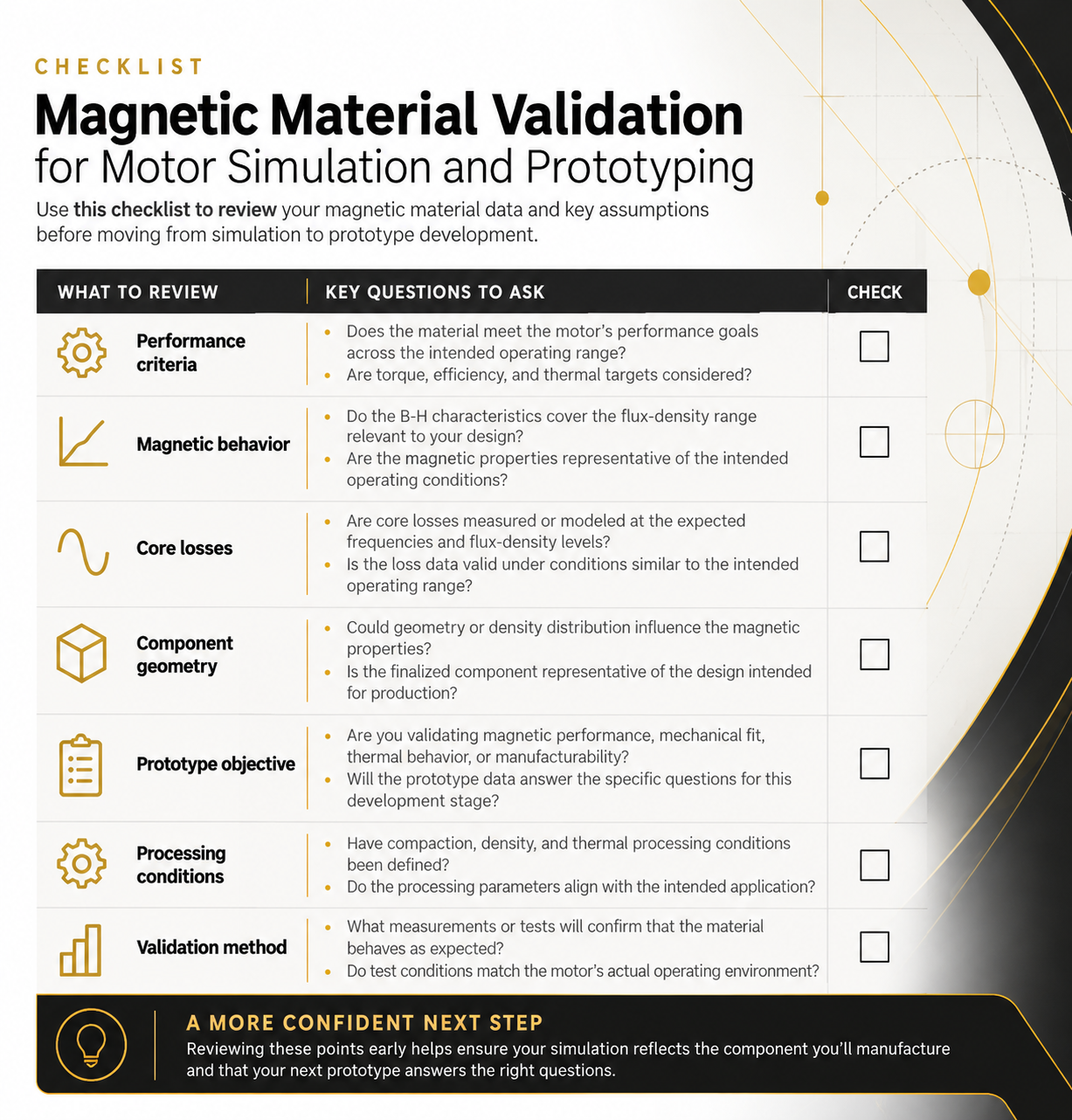
Not every development program requires the same level of testing. The important step is identifying which assumptions carry the greatest technical risk and addressing those first.
Building Confidence Before Building Hardware
Electromagnetic simulation has opened the door to motor designs that would have been difficult to evaluate efficiently just a few years ago.
But the ability to model increasingly complex magnetic circuits also makes it important to understand the materials behind those models.
For engineers exploring SMCs and other soft magnetic materials, the opportunity is not simply to substitute one material for another. It's to consider how material properties, geometry, and manufacturing methods can work together to achieve the intended performance.
At Horizon Technology, we work with engineering teams to evaluate those relationships early in development, helping connect magnetic material selection and manufacturing considerations with practical validation strategies.
Working through a new motor design?
If you're evaluating magnetic material options, questioning the assumptions behind your simulation, or preparing for an initial prototype, we'd welcome the opportunity to review your material data, operating conditions, and component geometry.
Together, we can identify the most useful next validation step before committing to a larger development effort.
Frequently Asked Questions About Magnetic Material Data
Can I use standard material library data for electromagnetic motor simulations?
Yes. Standard material libraries are useful for preliminary design comparisons and evaluating motor concepts. However, the data may represent idealized or specific test conditions rather than the properties of a production-intent component. As development progresses, engineers should confirm that the magnetic properties reflect the selected material, processing conditions, and intended application.
Why might an SMC component perform differently than its simulation predicts?
Differences can result from several factors, including achieved density, thermal processing, material properties, and component geometry. Simulation assumptions and testing conditions can also contribute. Comparing predicted performance with representative material or component measurements helps engineers identify where adjustments may be necessary.
What magnetic material data should engineers request before prototyping a motor?
At a minimum, engineers should evaluate B-H characteristics and core-loss data relevant to their operating conditions. For Soft Magnetic Composites, understanding the material grade, expected density, and processing conditions is also important. The specific data required will depend on the motor topology, operating frequency, flux-density range, and the performance characteristics being validated.