
Updated September 24, 2026.
Sintered soft magnetic materials give engineers a practical way to combine magnetic performance, mechanical strength, complex geometry, and high-volume manufacturability in one component. They are especially useful in DC motors, solenoids, relays, actuators, sensors, and magnetic flux-return paths where the component must magnetize and demagnetize efficiently while also surviving mechanical loads.
The central design advantage is not one universally superior alloy. It is the ability to tune the material and manufacturing process around the application’s working point.
What Is a Sintered Soft Magnetic Material?
A sintered soft magnetic component is made by compacting ferrous powder into a net-shape or near-net-shape geometry and then sintering it to create metallurgical bonds between the particles. Depending on the alloy and process, the component can provide useful permeability, induction, low coercive force, strength, dimensional control, and design freedom.
This material family should not be confused with soft magnetic composites used in higher-frequency AC applications. Sintered soft magnetic materials are metallurgically bonded and are generally selected for DC or lower-frequency devices. Soft magnetic composites use electrically insulated powder particles to limit eddy currents and support three-dimensional flux paths in AC machines.
That distinction matters because the most important loss mechanisms and design priorities change with frequency.
Start With the Magnetic Working Point
Material selection should begin with the device - not with a material name. The magnetic circuit, air gap, coil, duty cycle, temperature, and required response time determine which properties matter most.
The core questions are:
- How much magnetic flux density must the component carry at the intended field strength?
- How easily must it magnetize and demagnetize?
- How much residual magnetism can the device tolerate?
- Does the component carry a structural or rotating load?
- What temperature, duty cycle, and environment will it experience?
- Is the geometry difficult to machine, stamp, or assemble economically?
Answering these questions establishes the target for permeability, induction, coercivity, mechanical strength, density, and dimensional capability.
The Properties That Drive DC Magnetic Performance
Permeability
Permeability describes how readily a material supports magnetic flux when a magnetic field is applied. In practical terms, higher permeability can help a magnetic circuit reach the required flux with less magnetizing force. The useful value, however, depends on the full B-H curve and the device’s operating point - not simply the maximum permeability listed on a data sheet.
Magnetic Induction and Saturation
Induction indicates how much magnetic flux density the component develops at a stated field strength. Saturation describes the region where additional magnetizing force produces progressively less additional flux density. A design operating too close to saturation may require more current without delivering a proportional increase in force or torque.
Coercivity and Residual Induction
Coercivity is the field required to bring the material back toward a demagnetized state after magnetization. Residual induction describes the magnetism that remains when the applied field is removed. These properties can influence response, release behavior, heat generation, and control in relays, solenoids, and actuators.
Mechanical Strength
Magnetic performance cannot be separated from mechanical duty. A stationary flux-return path may need only modest strength. A rotor, rotating pole piece, or highly loaded actuator component may require substantially more tensile strength, fatigue resistance, or impact durability.
Choosing Among Common Material Families
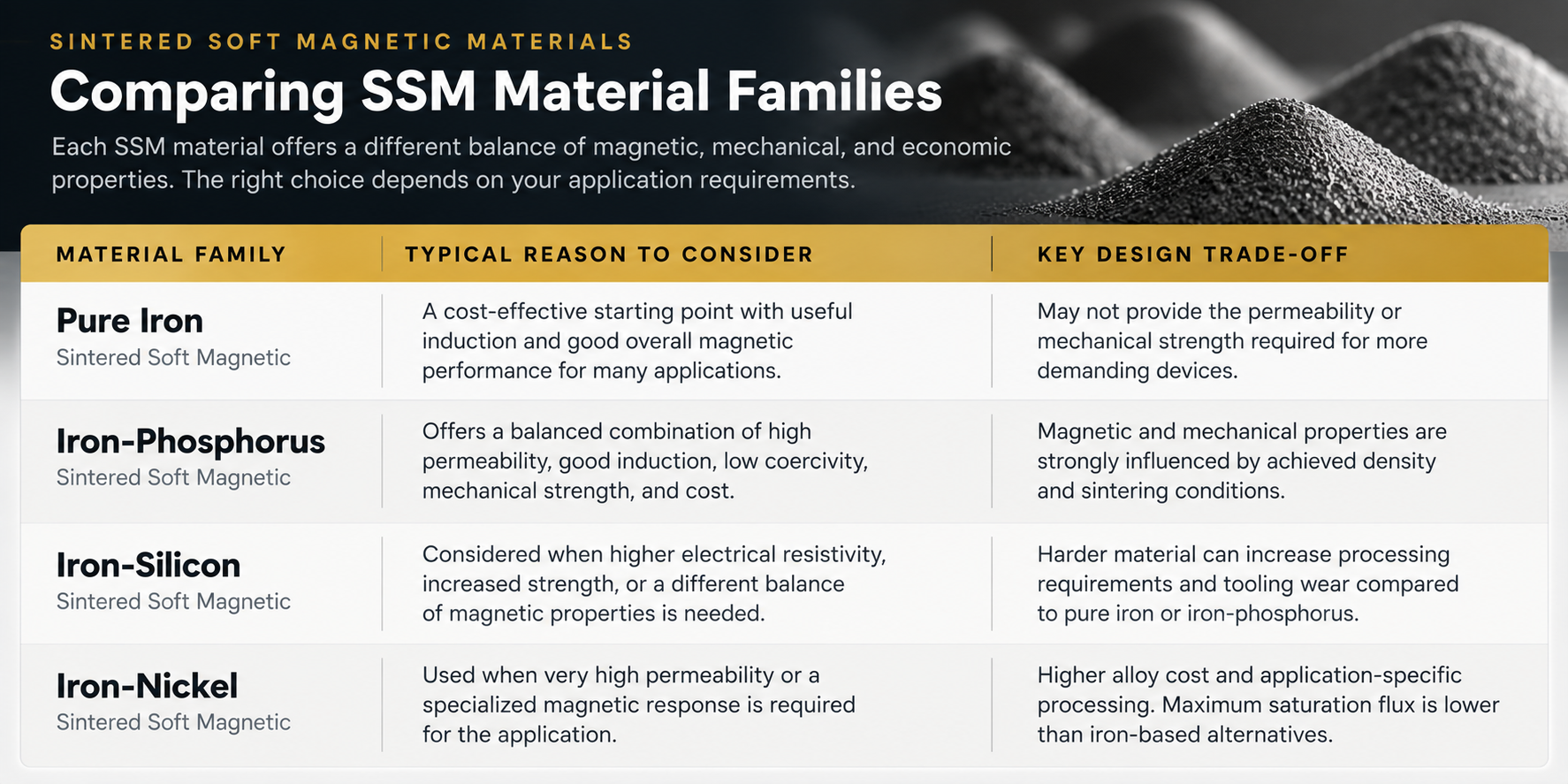
Published supplier data for pure iron and iron-phosphorus materials show the same practical pattern Horizon sees in development work: density and processing conditions can materially change the result. The material designation alone does not define the finished component’s performance.
Why Density and Sintering Conditions Matter
Higher density generally increases the amount of ferromagnetic material available to carry flux. It can also improve mechanical properties by reducing porosity. The result is often higher induction and improved permeability, although the exact relationship depends on alloy chemistry, compaction, lubrication, geometry, sintering atmosphere, temperature, and cooling practice.
Sintering atmosphere matters because oxygen, carbon, and other contaminants can interfere with magnetic domain movement. Sintering temperature influences diffusion, pore shape, chemistry, and strength. For high-performance magnetic components, these are design variables - not merely production settings.
This is why magnetic development should use representative production processing and component geometry whenever possible. Data from a generic laboratory specimen are useful for screening, but they do not replace testing of the actual magnetic circuit.

Balance Magnetic and Mechanical Requirements Together
The best material is rarely the one with the highest value in a single column. A pure-iron component may satisfy induction and cost requirements but miss a strength target. An iron-phosphorus or iron-silicon system may improve the combined magnetic and mechanical balance. A specialized iron-nickel material may be justified only when the application truly benefits from its higher-cost performance.

The decision should be made against a complete requirement set:
- B-H response at the intended working point
- Maximum and incremental permeability
- Coercivity and residual induction
- Saturation margin
- Tensile, yield, fatigue, or impact requirements
- Geometry and compaction direction
- Tolerance and secondary-operation needs
- Annual volume and total delivered cost
Design the Component and Process at the Same Time
Powder metallurgy creates the most value when the magnetic circuit and component geometry are developed together. Net-shape features, integrated functions, controlled density, and reduced assembly can change the economics of the complete device—not simply the price of one part.
Early collaboration also helps identify risks such as density gradients, thin walls, sharp transitions, ejection loads, distortion, or flux bottlenecks before tooling is committed.
For a new DC magnetic application, the most useful starting package is a drawing or concept geometry plus the target B-H working point, coil conditions, air gap, duty cycle, temperature, mechanical loads, annual volume, and available assembly space. From there, material, density, sintering, and geometry can be evaluated as one system.
Frequently Asked Questions
Are sintered soft magnetic materials only used in motors?
No. They are also used in solenoids, relays, actuators, sensors, pole pieces, flux-return paths, and other electromagnetic devices.
Is higher permeability always better?
No. The component must meet the device’s induction, saturation, residual magnetism, response, strength, cost, and manufacturability requirements. Maximum permeability by itself does not determine device performance.
What is the difference between sintered soft magnetics and SMC?
Sintered soft magnetic materials are metallurgically bonded and commonly used in DC or lower-frequency applications. Soft magnetic composites contain electrically insulated particles and are typically evaluated for AC or higher-frequency applications with three-dimensional flux.
When should Horizon become involved?
Ideally, before the magnetic circuit and component geometry are frozen. Early material and process input creates more opportunity to improve performance, simplify assembly, and avoid tooling constraints.